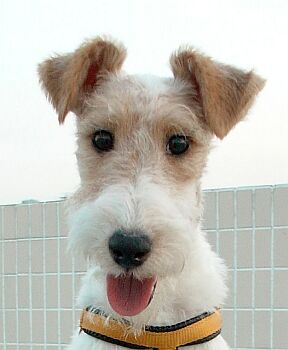
Border Terrier Dog Breed


A Border Terrier is a small, rough-coated breed  of dog of the terrier  group. Originally bred as fox and vermin hunters, Border Terriers share ancestry with Dandie Dinmont Terriers and Bedlington Terriers.

Though the breed is much older, the Border Terrier was officially recognized by the The Kennel Club in Great Britain in 1920, and by the American Kennel Club (AKC) in 1930.

In 2006, the Border Terrier ranked 81st in number of registrations by the AKC, while it ranked 10th in the United Kingdom.

In 2008, the Border Terrier ranked 8th in number of registrations by the UK Kennel Club.
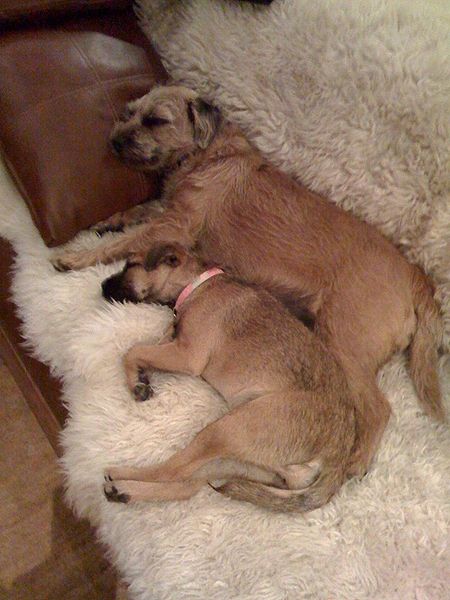

Appearance
Identifiable by their otter-shaped heads, Border Terriers have a broad skull and short, strong muzzle with a scissors bite. The V-shaped ears are on the sides of the head and fall towards the cheeks. Common coat colors are grizzle-and-tan, blue-and-tan, red, or wheaten. Whiskers are few and short. The tail is naturally moderately short, thick at the base and tapering.

Narrow-bodied and well-proportioned, males stand 13 to 16 in (33 to 41 cm) at the shoulder, and weigh 13 to 15.5 lb (5.9 to 7.0 kg); females 11 to 14 in (28 to 36 cm) and 11.5 to 14 pounds (5.2 to 6.4 kg).

The Border Terrier has a double coat consisting of a short, dense, soft undercoat and harsh, wiry weather and dirt resistant, close-lying outer coat with no curl or wave. This coat usually requires hand-stripping twice a year to remove dead hair. It then takes about eight weeks for the top coat to come back in. For some dogs, weekly brushing will suffice. Most Border Terriers are seen groomed with short hair but longer hair can sometimes be preferred.


Temperament
Though sometimes stubborn and strong willed; border terriers are, on the whole very even tempered, and are rarely aggressive. Border Terriers generally get along well with other dogs and are often good with children.

Borders do well in task-oriented activities and have a surprising ability to jump high and run fast given the size of their legs. The breed has excelled in agility training, but they are quicker to learn jumps and see-saws than weaving poles. They take training for tasks very well, but appear less tractable if being taught mere tricks.

They are intelligent and eager to please, but they retain the capacity for independent thinking and initiative that were bred into them for working rats and fox underground. Their love of people and even temperament make them fine therapy dogs, especially for children and the elderly, and they are occasionally used to aid the blind or deaf. From a young age they should be trained on command.

Borders can adapt to different environments and situations well, and are able to deal with temporary change well. They will get along well with cats that they have been raised with, but may chase other cats and small animals such as mice, rabbits, squirrels, rats, and guinea pigs.

Borders love to sit and watch what is going on. Walks with Borders will often involve them sitting and lying in the grass to observe the environment around them. They can be stubborn when they are tired and often require short breaks to sit and observe during long walks; it can be difficult to get them moving again.


Health
Borders are a generally hardy breed, though there are certain genetic health problems associated with them, including:

    * Hip dysplasia
    * Perthes disease
    * Various heart defects
    * Juvenile cataracts
    * Progressive retinal atrophy
    * Seizures
    * Canine Epileptoid Cramping Syndrome (CECS)
Border Terriers are also known to be sensitive to anaesthetics and slow to induce.

Due to their instinct to kill and consume smaller animals, Border Terriers often destroy, and sometimes eat, toys that are insufficiently robust. Indigestion resulting from eating a toy can cause the appearance of illness. Typical symptoms include lethargy, unwillingness to play, a generally 'unhappy' appearance, lack of reaction to affection, and inability or unwillingness to sleep. These symptoms are generally very noticeable, however, they are also present just prior to Border Terrier bitches being on heat. They are strong-willed, very lively, and also like running.


Earthdog trials
Border Terriers have earned more American Kennel Club (AKC) Earthdog titles than any other terrier. An AKC earthdog test is not true hunting, but an artificial, non-competitive, exercise in which terriers enter 9 in (23 cm) wide smooth wooden tunnels, buried under-ground, with one or more turns in order to bark or scratch at caged rats that are safely housed behind wooden bars. The tests are conducted to determine that instinctive traits are preserved and developed, as the breed originators intended for the dogs to their work. While earthdog tests are not a close approximation of hunting, they are popular in the U.S. and in some European countries because even over-large Kennel Club breeds can negotiate the tunnels with ease, dogs can come to no harm while working, and no digging is required. Since Border Terriers are "essentially working terriers", many Border Terrier owners consider it important to test and develop their dogs' instinct. These tests also provide great satisfaction for the dogs. The American Working Terrier Association (AWTA) does conduct "trials"; where the dogs instincts are tested, and then judged to determine a "Best of Breed" Earthdog. These trials are also run similar as described below.


History
The Border Terrier originates in, and takes its name from the Scottish borders. Their original purpose was to bolt foxes which had gone to ground. They were also used to kill rodents, but they have been used to hunt otters and badgers too.

The first Kennel Club Border Terrier ever registered was The Moss Trooper, a dog sired by Jacob Robson's Chip in 1912 and registered in the Kennel Club's Any Other Variety listing in 1913. The Border Terrier was rejected for formal Kennel Club recognition in 1914, but won its slot in 1920, with the first standard being written by Jacob Robson and John Dodd. Jasper Dodd was made first President of the Club.

Famous Border Terriers

    * Puffy in There's Something About Mary
    * Puffy's female offspring Raleigh, Clay Aiken's pet dog
    * Baxter in Anchorman: The Legend of Ron Burgundy
    * Hubble in Good Boy!
    * Co-star in Lassie (Named "Toots")
    * Seymour in Futurama as main character Philip J. Fry's pet dog when he worked at Pinucchi's Pizza
    * Lady Eccles in Coronation Street as Blanch's inheritance gift from her friend
    * Scamp in The Suite Life of Zack & Cody as Maddie's scruffy dog who falls in love with London Tipton's Pomeranian, Ivana
    * Shep Proudfoot, Greg Laswell's pet dog
    * Mackenzie, the dog of the Champion
    * Nancy in Unfabulous as Addie's pet dog
    * Chomp in 102 Dalmatians
    * Tansy as Toto from Return To Oz (1985 Disney film)
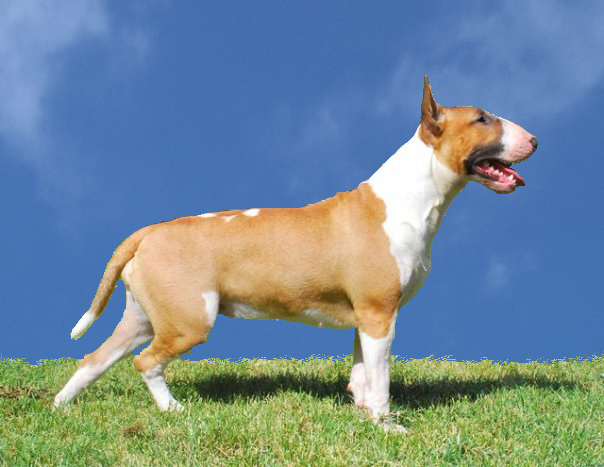
Bull Terrier Dog Breed

The Bull Terrier or English Bull Terrier is a breed of dog in the terrier family. They are known for their large, egg-shaped head, small triangular eyes and their "jaunty gait." Their temperment has been described as generally fun-loving, active and clownish, but also erratic and unpredictable. Bull terriers have appeared as characters in many cartoons, books, movies, and advertisements, perhaps most famously as party loving Spuds MacKenzie in Budweiser  beer commercials in the late 1980s, and more recently as the Target dog.


Appearance
The Bull Terrier's most recognizable feature is its head, described as 'egg shaped' when viewed from the front, almost flat at the top, with a Roman muzzle sloping evenly down to the end of the nose with no stop. The unique triangle-shaped eyes are small, dark, and deep-set. The body is full and round, while the shoulders are robust and muscular and the tail is carried horizontally. Bull terriers are known to have more muscle than any other breed of dog pound for pound. It walks with a jaunty gait, and is popularly known as the 'gladiator of the canine race'.

There is no designated height or weight for the breed but the average is, Height: 51-61 cm (20-24 inches), Weight: 20-38 kg (44-85 pounds) The Bull Terrier and the Miniature Bull Terrier are the only recognized breeds that have triangle-shaped eyes.


Temperament
Though this breed was once a fierce gladiator, it is much gentler today. A Bull Terrier might have a preventive effect and it will certainly defend its owner in a truly critical situation. Bull terriers are known to be courageous, scrappy, fun-loving, active, clownish and fearless. The Bull Terrier is a loyal and polite dog. They become very attached to their owners. The Bull Terrier thrives on firm, consistent leadership and affection and makes a fine family pet. Bull Terriers like to be doing something and fit in well with active families where they receive a great deal of companionship and supervision. They do not do well in situations where they are left alone for 8 hours a day. This breed can be a wonderful pet if very thoroughly socialized and trained, but not recommended for most households. Fond of both grown-ups and children, but if they do not get enough physical and mental exercise they may be too energetic for small children. Children should be taught how to display leadership towards the dog. Meek owners will find them to become very protective, willful, possessive and/or jealous. Bull Terriers may try to join into family rough housing or quarrel. Bull Terriers must be given a lot of structure. Be sure to socialize them well and remain their pack leader 100% of the time, otherwise, they can be extremely aggressive with other dogs. Unaltered males may not get along with other male dogs. Males and females can live together happily and two females can also be a good combination with care and supervision. They are not recommended with other non-canine pets such as cats, hamsters, and guinea pigs. They make excellent watch dogs.


Health
All puppies should be checked for deafness, which occurs in 20% of pure white dogs and 1.3% of colored dogs and is difficult to notice, especially in a relatively young puppy. Many Bull Terriers have a tendency to develop skin allergies.Insect bites, such as those from fleas, and sometimes mosquitoes and mites, can produce a generalized allergic response of hives, rash, and itching. This problem can be stopped by keeping the dog free of contact from these insects, but this is definitely a consideration in climates or circumstances where exposure to these insects is inevitable. Their lifespan is somewhere between 10 and 14 years,although they can live longer - a male bull terrier house pet in South Wales, UK by the name of "Buller" lived to the age of 18 years.The oldest female Bull Terrier on record is an Australian house pet dubbed "Puppa Trout" who remained sprightly into her 17th year.The second oldest female Bull Terrier on record is "Boots Moon Stomp Stout (Crain)" of Denver, Colorado USA. Boots lived to be 16 years of age.


The Bull Terrier's coat is easy to maintain, but grooming can keep it in near-perfect condition. Adding oils to their meals can also vastly improve the quality of their coat.English Bull Terriers have thin, fine hair that requires minimal grooming. They are known to have light shedding patterns. Another important issue is that any whiteness around the eyes, ears, nose, mouth, stomach or hindquarters with a short and sparse haired breed such as this must be protected against the sun with a gentle but high SPF factored sunscreen to prevent sunburn and subsequent cancer.The Bull Terrier requires a fair amount of exercise, but overworking the dog at a young age will cause strained muscles.Older dogs do require exercise, but in small doses, whereas younger ones will be happy to play for hours on end. The breed is renowned for being extremely greedy.

Other common ailments: Umbilical Hernia and Acne. Bull Terriers can also suffer from obsessive compulsive disorder, such as tail chasing, self mutilation, and obsessive licking.


History
Early in the mid-1800s the "Bull and Terrier" breeds were developed to satisfy the needs for vermin control and animal-based blood sports. The "Bull and Terriers" were based on the Old English Bulldog (now extinct) and one or more of Old English Terrier and "Black and tan terrier", now known as Manchester Terrier. This new breed combined the speed and dexterity of lightly built terriers with the dour tenacity of the Bulldog, which was a poor performer in most combat situations, having been bred almost exclusively for killing bulls and bears tied to a post. Due to the lack of breed standards -- breeding was for performance, not appearance -- the "Bull and Terrier" eventually divided into the ancestors of "Bull Terriers" and "Staffordshire Bull Terriers", both smaller and easier to handle than the progenitor.


About 1850, James Hinks started breeding "Bull and Terriers" with "English White Terriers" (now extinct), looking for a cleaner appearance with better legs and nicer head. In 1862, Hinks entered a bitch called "Puss" sired by his white Bulldog called "Madman" into the Bull Terrier Class at the dog show held at the Cremorne Gardens in Chelsea. Originally known as the "Hinks Breed" and "The White Cavalier", these dogs did not yet have the now-familiar "egg face", but kept the stop in the skull profile.


The dog was immediately popular and breeding continued, using Dalmatian, Greyhound, Spanish Pointer, Foxhound and Whippet to increase elegance and agility; and Borzoi and Collie  to reduce the stop. Hinks wanted his dogs white, and bred specifically for this. Generally, however, breeding was aimed at increasing sturdiness: three "subtypes" were recognised by judges, Bulldog, Terrier and Dalmatian, each with its specific conformation, and a balance is now sought between the three. The first modern Bull Terrier is now recognised as "Lord Gladiator", from 1917, being the first dog with no stop at all.

Due to medical problems associated with all-white breeding, Ted Lyon among others began introducing colour, using Staffordshire Bull Terriers in the early 20th century. Coloured Bull Terriers were recognised as a separate variety (at least by the AKC) in 1936. Brindle is the preferred colour, but other colours are welcome.

Along with conformation, specific behaviour traits were sought. The epithet "White Cavalier", harking back to an age of chivalry, was bestowed on a breed which while never seeking to start a fight was well able to finish one, while socialising well with its "pack", including children and pups. Hinks himself had always aimed at a "gentleman's companion" dog rather than a pit-fighter—though Bullies were often entered in the pits, with some success. Today the Bullie is valued as a comical, mischievous, imaginative and intelligent (problem-solving) but stubborn house pet suitable for experienced owners.


Bull Terrier facts
    * The Afrikaans name for the Bull Terrier is Varkhond
    * There is also a miniature version of this breed; this distinct breed is officially known as the Miniature Bull Terrier.

    * Bull Terriers are prominently featured in Jonathan Carroll's 1980 novel The Land of Laughs.

    * Bull Terriers have appeared in many movies, including: A Dog's Life (1918), It's a Dog's Life (1955), Oliver!, Baxter, Patton, Toy Story, Babe: Pig in the City, Next Friday, Friday After Next, Frankenweenie, Trainspotting, Bulletproof, Derailed, "Scotland, PA", The Incredible Journey, Space Buddies and Snatch.

    * A Bull Terrier appears in several scenes of the 1976 film Je t'aime... moi non plus.

    * Bull Terriers have also featured in television shows such as the 1970s television show Baa Baa Black Sheep, in the opening credits of the British television show Barking Mad, and in the short lived Fox series Keen Eddie.
    * A Bull Terrier is the main character in a Max Brand novel "The White Wolf".

    * Spuds Mackenzie, a dog featured in an advertising campaign for Bud Light beer in the late 1980s, was a bull terrier.

    * American children's writer and illustrator Chris Van Allsburg features a bull terrier named Fritz in at least one scene in every book.


Famous Bull Terriers
    * Abraxas Aaran, who portrayed Willie, the title character's dog, in the 1970 film Patton.
    * Baxter, from the film Baxter - with the tagline, "Méfiez-vous du chien qui pense." ("Beware the dog that thinks.")
    * Blue, owned by Canadian hockey commentator Don Cherry, is widely considered to be almost as famous as Cherry himself.
    * Bodger, an old white bull terrier, is a major character in the book The Incredible Journey by Sheila Burnford and the movie
    * Brut, in the novel, Answers to Brut, by Gillian Rubinstein
    * In Charles Dickens' novel Oliver Twist, Bill Sykes owns an English Bull Terrier named Bullseye.
    * Bullseye mascot of the Target Corporation
    * Chester, Chad's (Preppy) dog in Rockstar Vancouver's video game Bully
    * Chico, a dog in Next Friday and Friday After Next
    * Creampuff, one of Irish Murphy's pig hunting dogs from the Footrot Flats comic series.
    * Kirk Hammett of the thrash metal band Metallica has a bull terrier named Darla.
    * Dave, an old white bull terrier of the Priory Estate.
    * Hip-Hop artist Adil Omar has a bull terrier named Diablo.
    * Fritz, the black-and-white bull terrier who appears in every Chris Van Allsburg book.
    * Grimm, of the cartoon series Mother Goose and Grimm.
    * Odd's dog, Kiwi, is rumored to be a bull terrier but he looks more like a Whippet.
    * Jock, one of the most famous dogs in South Africa. He was the companion of the Percy Fitzpatrick. A book was written about him by Fitzpatrick, It was called Jock of the Bushveld.
    * Lockjaw, Pepper's companion in Sierra's Pepper's Adventures in Time.
    * Meatball, White bull terrier pet of Major Gregory "Pappy" Boyington in Baa Baa Black Sheep (TV series).
    * Pete, from the Fox-television series "Keen Eddie", 13 episodes, 2003
    * Rex from the film Stealing Harvard. Rex is a mean dog who always agrees with his master. However, his crankyness goes away when he tries to bite a man in the crotch and ends up falling in love and having sex with him.
    * Rick Springfield's bull terrier Ronnie appears on the cover of his album Working Class Dog.
    * Rude Dog
    * Sam, who accompanied Alby Mangels, Dutch-Australian adventurer, on his world travels.
    * Scud, from the Disney/Pixar film Toy Story.
    * Sparky, the dog who appears in "Frankenweenie"
    * Spuds MacKenzie - "star" of Bud Light beer commercials in the late 1980's
    * Spunky, of Rocko's Modern Life, resembles a Bull Terrier and was also the name of a famous MA Bull Terrier.
    * Whiskey, from the Eidos Commandos series
    * Willie, owned by World War II US Army General George S. Patton and named after William the Conqueror.
    * Unnamed bull terriers regularly appearing in New Yorker cartoonist George Booth's cartoons. 
The dog from Angry Kid
    * Mumps, the bull terrier who wanders around with Bob Jakin, a prominent character in the novel "The Mill on the Floss" by George Eliot.

Fox Terrier dog breed

The name Fox Terrier or Foxy refers primarily to two different breeds of dog, the Smooth Fox Terrier and the Wire Fox Terrier, that were independently bred in England in the mid-19th century. The two terrier breeds are very similar, with the only major difference being the coats. The Smooth Fox Terrier has a smooth, flat, but hard and dense coat, whereas the Wire Fox Terrier coat should appear broken with a dense, wiry texture.

In show circles, the terms fox terrier and foxy are only used for these two breeds, but in other communities around the world, particularly rural and farming areas, these words are used for these breeds and also to refer to mixed-breed dogs or working terriers of fox terrier type, or to descendent breeds such as the Toy Fox Terrier and Miniature Fox Terrier, which are similar to each other.

Origin
This dog's breeds were established to assist in fox hunting. Before their development, a hunt would be ruined as soon as the fox reached its hole. The introduction of Fox Terriers into the hunting party solved the problem. If the fox "went to ground" (reached and entered its lair), the terrier would be sent in after it. This identified the major requirements for a Fox Terrier. Firstly, it had to have the stamina to run with the Foxhounds. Secondly, it had to be small enough to follow a fox down its lair. And thirdly, it had to be tough, as a cornered fox was likely to turn and try to fight off an intruder, so a foxy had to be able to stand up to it.

The term Fox Terrier was generic until the latter part of the 19th Century. It referred to a group of dogs of varying type which were bred for the hunt. These dogs were often called "foxies" regardless of type or size. The first Fox Terrier, a dog called "Foiler" or "Old Foiler", was registered by the Kennel Club circa 1875-6, and the breed began the process of standardization.

Refinement of breed types led to the assignment of new breed names to the ensuing breeds. A differentiation was made between the Fox Terrier varieties, although the two breeds were shown under the same breed standard until well into the 20th century. The process of selective breeding was duplicated in other countries as emigrants took their dogs to other parts of the world.

Click on image to view large

Development of the Fox Terrier around the world
In the United States, fanciers of the Jack Russell Terrier were adamant that their dog, of a type created by The Reverend Mr. John Russell, “The Sporting Parson”, was as much of a fox terrier as the smooth or wirehaired varieties. They referred to those breeds as the Modern Fox Terriers. Some Jack Russell owners preferred that their breed clubs remain unaffiliated, to preserve the working qualities of their fox terrier.

The Toy Fox Terrier was developed by selected breeding from smaller Fox Terriers. The breed was recognized by the United Kennel Club in 1936 and generated little controversy.

Smooth and Wirehair Fox Terriers are often referred to as Standard Fox Terriers in Australia in an attempt to minimize confusion.

Today, there are many and varied breeds that are descended from or related to earlier fox terrier types. These include the

    * Brazilian Terrier
    * Japanese Terrier
    * Miniature Fox Terrier
    * Ratonero Bodeguero Andaluz
    * Rat Terrier
    * Tenterfield Terrier
    * Chilean Fox Terrier
    * Toy Fox Terrier

The Smooth and Wirehair Fox Terriers are seldom used for hunting these days and are more often pets. Their small size makes them appealing.

Coloring
Genetically, both Smooth and Wire Fox Terriers have base colors of tan or black and tan. The white coloring derives from a "spotting gene", which acts to restrict the formation of color to a greater or lesser degree. This is not related to albinism  in any way. The alleles in the series that are believed present in Fox Terriers are sp for "piebald" markings (random spots, saddles, or even blankets of color, with the head solid color or exhibiting some white in blaze or half face) and sw, extreme white, which restricts color to virtually none or eye and ear patches. Pigment of the nose, lips, pads, and so on remain black in all cases. Eye rims are always black where there is color surrounding, but eyes surrounded by white may get rim pigment gradually or sometimes not at all.


Termperament
As described in the FCI standard for the wire-haired fox terrier, the terrier "should be alert, quick of movement, keen of expression, on the tip-toe of expectation at the slightest provocation."

Maintenance
Fox Terriers need to have their nails clipped regularly, whether exercised or not. Their hair needs stripping on a frequent basis to keep well maintained. Especially with wire haired fox terriers, trimming the hair instead of stripping it causes the colors to become dull and the coat to become soft and curly.